
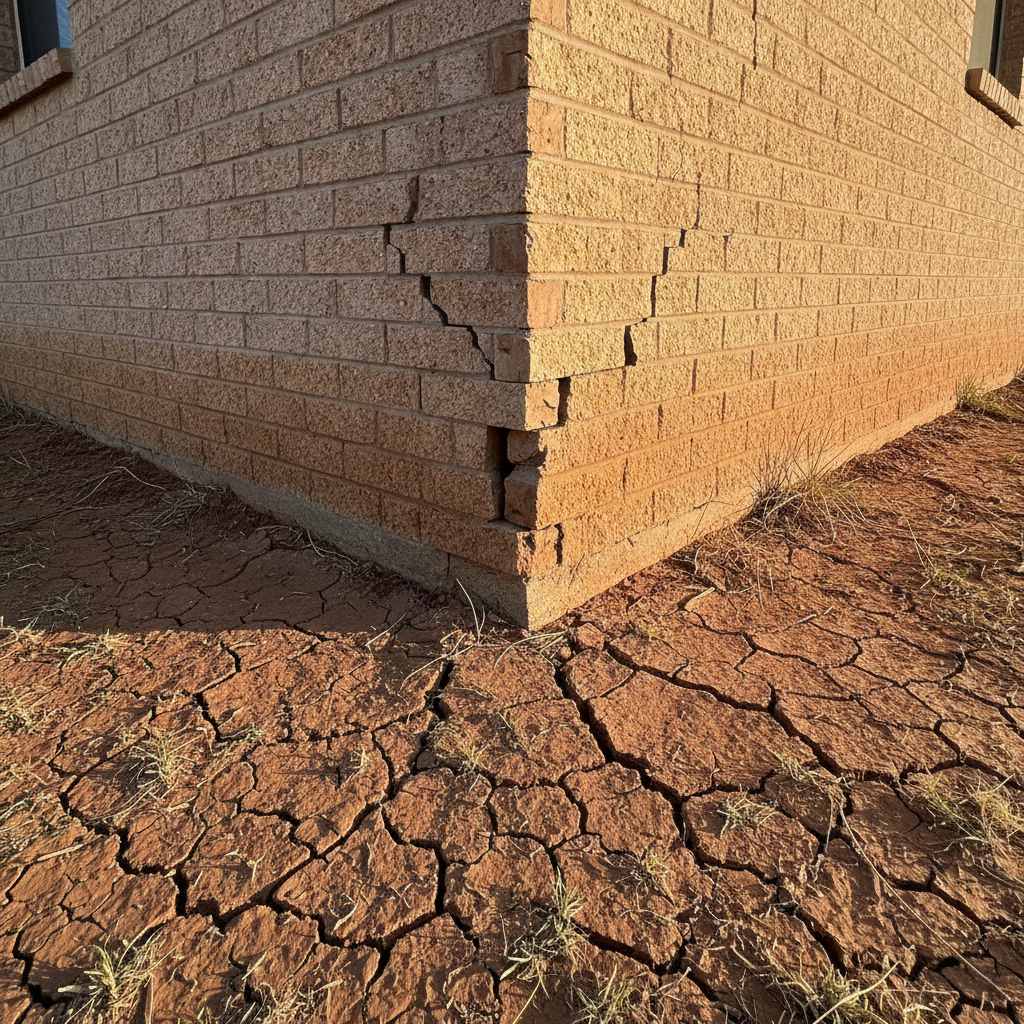
According to Google Trends data, Kansas ranks first and Texas second nationwide in foundation repair searches over the 12-month period spanning January 20, 2025, to January 20, 2026. That is not a fluke. GroundWorks released the data just this year, and the number should worry every North Texas property owner because it signals a real problem, not just homeowner anxiety.
What the Data Actually Tells Us
Texas ranks high in foundation repair searches because expansive clay soils are a major contributor to foundation instability in both Kansas and Texas. Texas is widely known for Houston Black clay soil (often called "Black Gumbo"), and the area covering Dallas through Tarrant to Collin and Denton counties is among the worst with over 50% clay content. That is not news. What matters is why homeowners are searching now, in 2026, more than they were in 2023.
The honest answer involves three mechanical realities stacked on top of each other. First, Texas is home to an abundance of Vertisols, a category of highly expansive clay soils that swell dramatically when they absorb moisture and shrink just as dramatically when they dry out. This clay can expand in volume by as much as 30 to 40 percent when fully saturated. When you pour a concrete slab or install piers into soil with that kind of movement capability, every cycle of drought and rain is a stress test your foundation either passes or fails.
Second, clay soil absorbs water quickly during rainy periods and swells significantly. During dry weather, the same soil shrinks as moisture evaporates. This repeated expansion and contraction creates uneven pressure beneath your home. That uneven pressure is the killer. One edge of your slab may be pushing up while another drops, or different sections may move at different rates depending on tree roots, drainage patterns, or how the yard was graded. The concrete or timber gets pulled in multiple directions, and it cracks.
Third, and this is the uncomfortable part for builders and warranty administrators, drainage conditions are often not properly established prior to the foundation pour. Reinforcement placement can be inconsistent, and slab elevation provided minimal tolerance for water movement away from the structure. Improper site drainage amplifies soil movement because water doesn't drain uniformly around the perimeter. A wet zone on one side of your home stays saturated while the opposite side dries out faster. Your foundation sees the worst of both worlds.
Why the Searches Are Rising Now
Construction activity in Texas has been brisk. With over 250,000 new housing permits issued annually and commercial development surging across Austin, Dallas-Fort Worth, Houston, and San Antonio, the Lone Star State leads the nation in new construction. Many of those homes are on expansive clay. The homes built during 2018 to 2023 are now three to eight years old. At that point, many cases center on homes built between 2018 and 2023. Construction during the pandemic-era housing boom faced material shortages and labor challenges that allegedly contributed to quality issues.
Latent defects are also showing up. Foundation preparation issues, framing defects, improper flashing, air sealing failures, and mechanical system installation problems are among the most common findings. These are not rare conditions. They are recurring issues that develop during construction and are often concealed before they can be identified. Once a slab is poured and the framing is erected, nobody can see what is underneath. A homeowner may not realize there is a problem until the soil has gone through multiple wet-dry cycles and movement becomes visible.
Warranty deadlines matter. Texas new construction warranties follow a tiered timeline: one year for workmanship and materials, two years for mechanical systems like plumbing and electrical, and up to 10 years for structural defects. As of 2026, some builders have shortened structural coverage to six years under House Bill 2024. Homes built in 2020 are already approaching the edge of their mechanical system warranty window. If a drainage problem is just now manifesting itself as foundation movement, the buyer may be outside the warranty period, and the builder's obligation has ended.
What This Means for You
If you own a home on North Texas clay, especially if you built or bought in the 2018 to 2023 window, get a foundation inspection from a licensed professional engineer now, not when you are ready to sell. Do not wait for a problem to become obvious. A door that suddenly sticks in July, then swings freely again after a week of rain, is not just an odd house quirk in this part of Texas. It is often one of the first signs of north texas soil foundation issues. That is a signal that your soil is cycling and your structure is responding. Document it. Photograph any cracks. Get ahead of the warranty deadline.
If you are considering buying a home in North Texas, make the pre-purchase inspection a condition of the offer. Do not rely on the builder's final inspection or the city permit. Following municipal approval, drainage defects typically become civil matters. Municipalities do not assume responsibility for ongoing performance, and enforcement generally concludes at final inspection. Responsibility then shifts to the builder, developer, or other responsible parties, and disputes frequently arise regarding standard of care, scope of responsibility, and whether the condition constitutes a construction defect. The city signed off on the lot grading. That does not mean water is actually draining away from your foundation. Have it checked by someone who understands soil mechanics and drainage.
For any new construction, demand phase inspections before major concealment. The foundation stage and framing stage are the two moments when drainage, compaction, and reinforcement are still visible. After drywall is hung, it is too late. The most effective time to identify and correct deficiencies is during construction, before they are concealed and before closing reduces leverage.
Understand that the spike in foundation repair searches is not just homeowners worrying. It reflects real movement, real defects, and real costs. The soil under North Texas homes moves. The question is whether your home was built and maintained in a way that lets it move safely, or whether it is now paying the structural price for shortcuts taken five or six years ago.
Disusun dengan bantuan AI dan ditinjau terhadap sumber publik yang dirujuk di atas. Bukan pengganti inspeksi bersegel PE.