
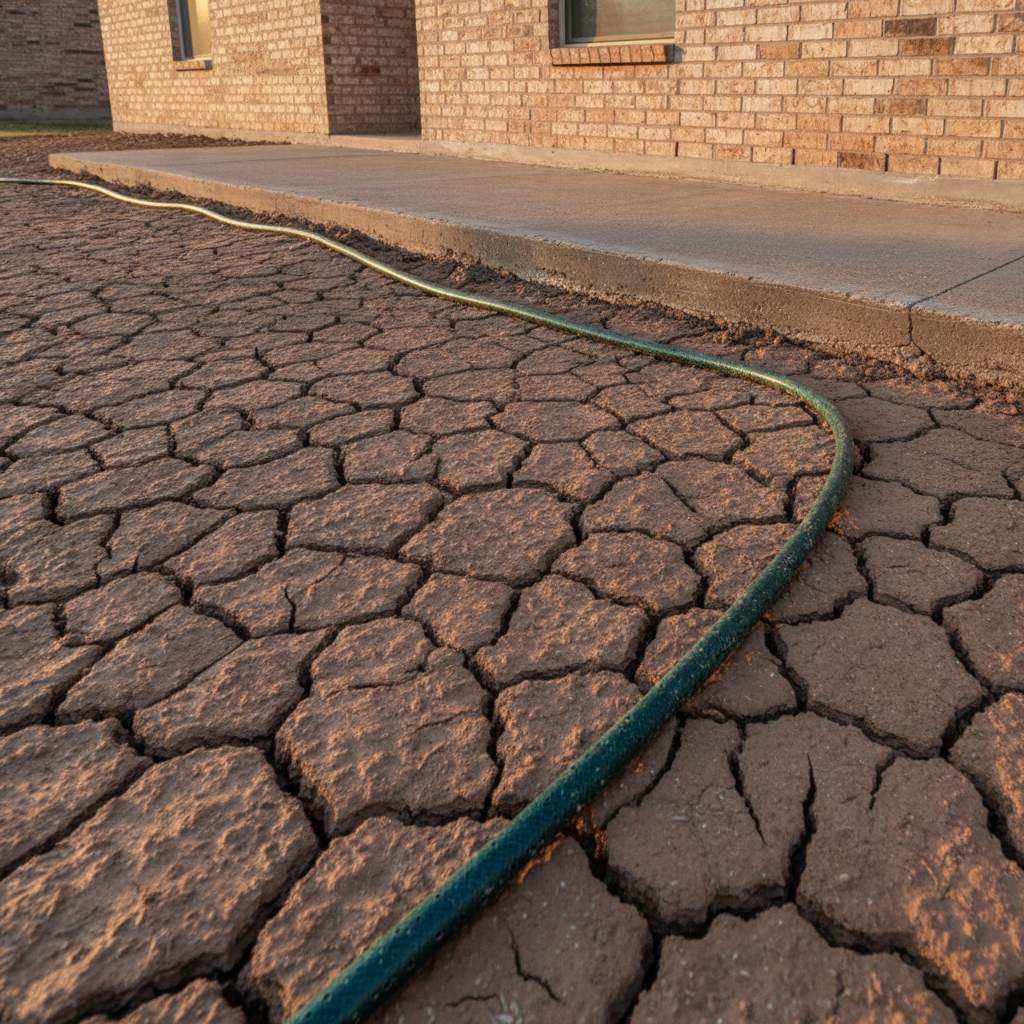
The Trigger
Contractors across North Texas keep repeating the same prescription: run your soaker hose "15-20 minutes a day" to protect your foundation during drought. One August 2026 DFW foundation consultant wrote exactly that, and the advice shows up everywhere from repair company websites to YouTube tutorials. Homeowners listen, install systems, and follow the script faithfully. But almost nobody asks: is 15 minutes actually enough to reach the clay that matters, and does daily watering prevent problems or create them?
The Physics: Why 15 Minutes Doesn't Move the Needle
The critical zone for foundation stability in North Texas clay isn't the top inch. Smectite clay mineral expansion in North Texas soils reaches 30% to 50% of dry soil volume, and that movement happens where the foundation actually bears load: 3 to 6 inches deep, and sometimes deeper. A 15-minute soaker hose session on dry clay does not penetrate that far consistently enough to matter.
Water moving through compacted clay soil is slow. A soaker hose foundation schedule should be steady rather than heavy, because watering for three hours once a week does less good than 30 minutes daily, since clay absorbs slowly and excess water simply runs off. But here's the trap: the script goes the other direction. Contractors recommend 15 minutes as a daily minimum, not as insufficient, which leaves homeowners watering in the false belief they're protecting the active zone when they're only dampening the surface.
A leading Texas A&M soil-foundation authority has stated foundation watering "theoretically works and practically doesn't" in Texas yards, with the issue being inconsistent watering and human error. That human error is baked into the 15-minute recommendation. It assumes daily execution without fail, timer maintenance, adjustment for rain, or the reality of travel, forgotten schedules, and water restrictions.
The Overwatering Risk Nobody Mentions
When homeowners do stay consistent with daily 15-minute watering, they often cross into a different failure mode: oversaturation. Saturated clay swells and can heave the slab, and constant wet soil against the house attracts termites. A slab that moves up from heave is as damaging as one that moves down from shrinkage. Both create stair-step cracks in brick, stuck doors, and structural stress.
The real guidance, rarely stated plainly, is narrower. For the Dallas, Fort Worth area, it is advisable to run the soaker hose for 15-20 minutes per day, three to five days a week, not seven days. That's a massive difference from the daily mantra. Yet the daily version persists because it sounds more protective, easier to remember, and contractors know that homeowners who think they're doing something (even if ineffective) are less likely to claim surprise later.
What Actually Works: Conditions, Not Schedules
In peak drought, 30 to 45 minutes a day or 60 to 90 minutes every other day is a common starting point, then adjusted until the soil 4 to 6 inches down stays damp but not muddy. That's not a single fixed rule. It's a condition-based approach that demands observation. The goal is stable soil moisture in the active zone, not adherence to a schedule.
Thomas Engineering Consultants (a DFW PE firm) recommends 12–18 inches from the foundation, buried 4–6 inches deep, and this is where engineering consensus sits. Distance matters. Placement matters. Duration matters. A 15-minute surface soaker placed too close to the slab can actually drive water down the concrete edge and under the house, making moisture problems worse instead of better.
If you're serious about reducing foundation movement, professionally installed foundation watering systems put buried drip lines on a dedicated zone with a rain sensor and moisture control, so the water goes deeper and more evenly than a surface hose can manage. A rain sensor alone eliminates the human error of watering after a heavy rain, which can trigger slab heave. Many homeowners with soaker hoses don't own one.
For Texas Homeowners: What This Means
If you have an engineer's report or inspection that actually recommends foundation watering, follow it. Don't follow TikTok. If you're installing a soaker hose system on your own, place it 12-18 inches from the foundation edge, bury it 4-6 inches deep, and run it for at least 30-45 minutes during peak summer drought, not 15 minutes, and not every single day. Use a timer with a rain sensor or adjust manually after every significant rainfall. You're managing soil moisture, not just performing a ritual.
If cracks are already visible or movement is documented, call a licensed PE for a foundation inspection before assuming watering will help. Some failures are past the point where moisture management helps. Some slab conditions make watering counterproductive. A cheap soaker hose system installed on a foundation that's already heaving can make the repair bill worse.
For contractors: if you're recommending soaker hose watering, be specific. State the duration, frequency, placement distance, and burial depth. Provide a written maintenance schedule. Better yet, recommend a buried drip system with automated controls if the homeowner can afford it. Vague "daily 15 minutes" advice protects you from liability but fails your customer. That's not engineering, it's noise.
The 15-minute daily script sounds professional and simple. That's exactly why it persists. But protecting a North Texas foundation from clay shrink-swell requires more precision than a catchphrase. Proper drainage and structural assessment should come first. Watering, if recommended, is secondary maintenance that works only if done correctly and consistently adjusted for conditions.
Disusun dengan bantuan AI dan ditinjau terhadap sumber publik yang dirujuk di atas. Bukan pengganti inspeksi bersegel PE.