
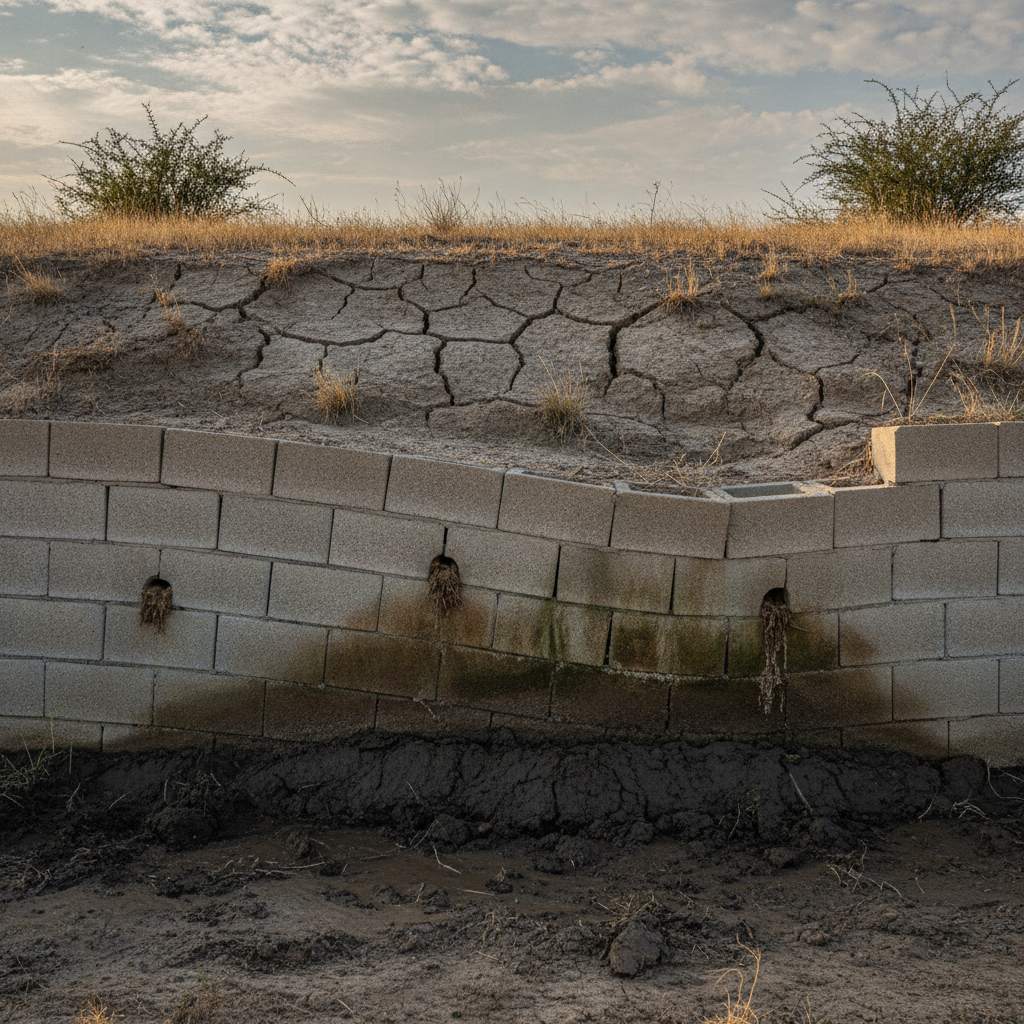
Earlier this year, a North Texas family watched their retaining wall collapse after a heavy rain and snowmelt. The wall had been leaning for months, and when the structure finally failed, it took four feet of their backyard with it. The homeowner felt it was obvious the wall needed repair, but understanding why it failed reveals a pattern that catches most people off guard: the material and engineering design had almost nothing to do with it.
The Invisible Force Behind the Failure
Over 80 percent of retaining wall failures are directly caused by poor drainage. Not poor engineering. Not cheap blocks. Not shallow footings as a primary cause. Water accumulation. What happens is physics, not opinion.
When rain saturates the soil behind your retaining wall with no exit route, that water doesn't just sit there inert. Rainwater seeping into the soil behind your wall with no escape route accumulates and turns the soil into a heavy, semi-liquid slurry that creates immense hydrostatic pressure. Wet clay becomes heavier and expands, which increases the load on the wall face. In North Texas clay, this pressure becomes extraordinary. Hydrostatic pressure builds up when water accumulates behind the wall, dramatically increasing failure risk. Without proper drainage systems like gravel backfill, perforated drain pipes, and weep holes, even strong walls can collapse.
You can purchase engineered Allan Block systems, specify concrete strength, hire a PE, and pass inspection. None of that stops water from pooling. A wall that looks beautiful on the surface is only half the project. The unseen components behind the face of the wall determine whether that structure stands for five years or fifty.
What Drainage Actually Looks Like (And What Corners Get Cut)
Every structural wall must include a perforated drain pipe and a 12-inch gravel drainage zone behind it. Geotextile fabric is required to prevent clay soil from washing into and clogging your drainage gravel. That's the standard. That's what the wall needs to survive North Texas weather.
What actually gets built? Walls without any drainage system at all, or systems so undersized or neglected they might as well not exist. Skipping drainage is the number one cause of retaining wall failure in the area and is not covered by most contractor warranties. Contractors know this. Homeowners mostly don't. The drainage work happens at grade level where nobody sees it, and where the margin between $3,000 and $20,000 in total cost gets erased with a hand gesture.
Then the wall gets built. It looks solid for a few seasons. Dry weep holes after rainfall may indicate that the drainage system has become clogged. When water cannot escape, pressure continues to build behind the retaining wall. The homeowner notices the wall leaning slightly. They think about calling someone. They wait. It's tempting to think "It's been like that for years, it's not going anywhere." But walls don't lean and then stop. They lean more. The structural integrity of a retaining wall depends on it being plumb and properly anchored. Once it begins to tilt, the forces acting on it become increasingly unbalanced and the process accelerates.
The North Texas Soil Multiplier
The DFW metroplex has a unique combination of expansive clay soil, extreme weather cycles, and aging housing stock that makes retaining walls fail faster and more often than almost anywhere else in the country. This isn't opinion. North Texas's expansive montmorillonite clay causes seasonal ground movement of 3 to 6 inches, far more than most older walls were built to handle. In clay-heavy regions, moisture changes amplify the problem. Wet clay becomes heavier and expands, which increases the load on the wall face. During drought periods, shrinking soil can create voids that later refill and shift.
Your wall doesn't just hold soil. It holds soil that swells in April, shrinks in August, and repeats the cycle relentlessly. That cyclical force, combined with hydrostatic pressure from poor drainage, is what pushes walls to fail.
What This Means for Your Property
If you are planning a retaining wall in North Texas, insist on a PE-stamped design that includes a drainage plan. Don't accept a proposal that glosses over the drainage detail. Ask specifically: where does the water go? What perforated pipe size? What depth of gravel backfill? Is geotextile included? If a contractor hesitates or waves these questions away, they are building a failure timeline, not a wall.
If you already have a retaining wall that is leaning, ask a structural engineer to evaluate it. Dry weep holes, white staining, horizontal cracks, visible wall movement, and settlement behind the wall can all indicate a hydrostatic pressure problem. These warning signs should not be ignored. A small correction now (often a drainage retrofit or helical pier installation) can prevent a collapse that costs $20,000 and loses yard space.
For pre-purchase property inspections or site assessments, a retaining wall check should always include drainage verification. An engineer can look at the slope of the ground, the condition of weep holes, and the soil behind the wall to estimate whether you are looking at a well-draining system or a pressure cooker. That distinction is worth knowing before you buy the property or authorize a repair.
A professional site evaluation will flag these issues. So will a drainage and grading assessment if you own property with slopes or walls. And if a wall is already failing, an engineer can design a repair or replacement that accounts for our specific soil and weather.
Disusun dengan bantuan AI dan ditinjau terhadap sumber publik yang dirujuk di atas. Bukan pengganti inspeksi bersegel PE.