
The Trigger
On March 3, 2026, a construction worker was killed after a retaining wall collapsed at a worksite on the South Side of San Antonio. Workers were building a retaining wall when the structure suddenly collapsed, causing a large amount of soil and debris to fall and trap one of the workers beneath it. Spagnoletti Law Firm reported that investigators would need to review the site's construction plans and safety procedures. This was not a freak accident or an act of nature. It was a structural failure waiting to happen, and it cost a life. That reality should shake every property owner and contractor in North Texas.
Why This Happens in Texas
Most retaining wall failures in North Texas are not about the wall itself falling over like a tree. They are about a hidden, relentless force building behind the structure until the wall cannot hold anymore. That force is hydrostatic pressure, and it is the physics of water trapped in soil.
A retaining wall failure is almost always a story about water. Soil on its own is heavy, but soil saturated with water is exponentially heavier and behaves more like a liquid. This creates hydrostatic pressure, which is the single most common cause of retaining wall failure. Here is what happens: after a rain event, water percolates into the soil behind the wall. If that water has nowhere to escape, it accumulates. As it accumulates, the soil becomes heavier and more fluid-like. Waterlogged soil dramatically increases the lateral load on the wall face. This waterlogged soil shifts from a manageable load to a fluid-like force that can push a wall to its failure point, often causing bowing or catastrophic collapse.
In North Texas, this problem compounds because of our expansive clay soils. The DFW metroplex has a unique combination of expansive clay soil, extreme weather cycles, and aging housing stock that makes retaining walls fail faster and more often than almost anywhere else in the country. Clay already holds water. Expansive clay expands when saturated and contracts during dry periods, which creates constant pressure changes behind the wall. Without proper engineering and drainage, that movement can quickly overwhelm a basic wall installation. Add inadequate drainage design, and you have a pressure cooker waiting for the next heavy rain.
The Backfill Problem
One of the most common shortcuts in North Texas retaining wall construction is the choice of backfill material. Many contractors backfill with on-site clay or compacted fill soil to save money. Improper backfill materials like clay or expansive soils lead to poor drainage. Clay-based backfill does not allow water to pass through it. Water pools. Pressure builds. The wall leans or bows. If the wall is not properly engineered with reinforcement, tiebacks, or adequate footing, it fails.
Industry data from the National Concrete Masonry Association reveals that over 80 percent of retaining wall failures are directly caused by poor drainage. When rainwater seeps into the soil behind a wall with no escape route, it accumulates and turns the soil into a heavy, semi-liquid slurry that creates immense hydrostatic pressure. This is not theory. This is documented failure pattern after failure pattern.
Why Engineering Matters
Retaining walls taller than 3 to 4 feet in North Texas are often subject to local building codes that require professional engineering. Many homeowners and contractors ignore this requirement. They assume a wall is just a wall, like a garden border. It is not. Walls taller than 3 to 4 feet may require engineered plans and permits, adding design and approval costs before construction begins. A PE-sealed design accounts for soil type, soil moisture conditions, drainage system design, footing depth and width, reinforcement needs, and possible surcharge loads from above.
Without engineering, you get a wall with poor footing, inadequate drainage, wrong backfill material, and no internal reinforcement. When hydrostatic pressure builds, the wall fails. It may fail slowly (leaning and cracking over months or years), or it may fail catastrophically (collapsing suddenly, as in San Antonio).
What This Means for You
If you own property in North Texas with a retaining wall, or you are considering building one, here are the hard truths:
- Get an engineering design first. Do not build based on a sketch or contractor estimate. A licensed PE must evaluate your soil conditions, drainage, and load requirements. This adds cost upfront but prevents total failure later.
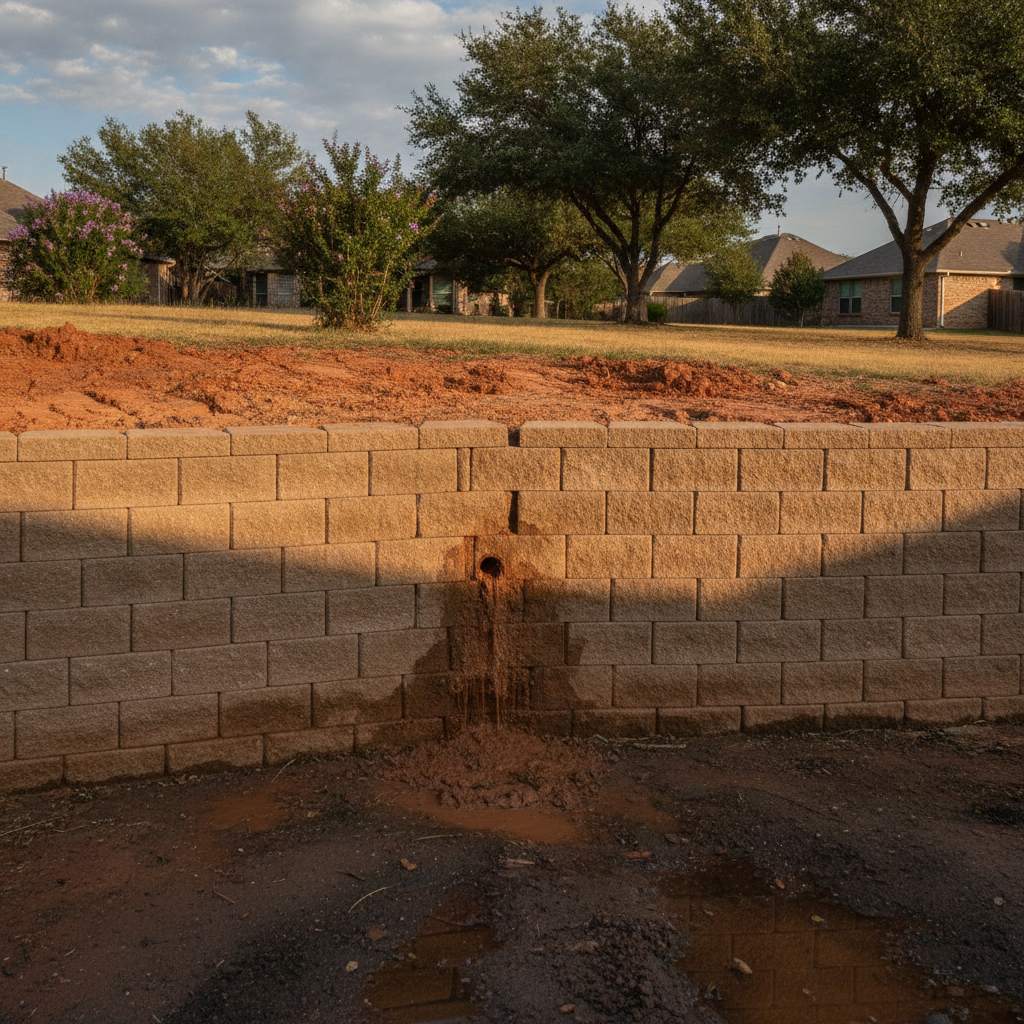
- Demand proper drainage in writing. Any retaining wall should include a perforated drain pipe at the footing, open-graded (free-draining) gravel backfill, geotextile filter fabric to prevent clay from clogging the gravel, and weep holes in the wall face at regular intervals. Every structural wall must include a perforated drain pipe and a 12-inch gravel drainage zone behind it. Geotextile fabric is required to prevent clay soil from washing into and clogging your drainage gravel. Get this in your contract. Verify it during construction.
- Use the right backfill material. For long-term durability in North Texas, segmental concrete blocks and free-draining backfill materials offer the strength and flexibility needed to withstand expansive clay soils. Do not allow clay or on-site soil to be dumped behind the wall. It will fail.
- Inspect regularly. If your wall begins to lean, bow, or show horizontal cracks, call a structural engineer or forensic engineer immediately. Early repair is far cheaper than emergency reconstruction or dealing with a collapse.
- Check for water weeping or damage to your drain outlets. The consistent appearance of water or fine soil particles weeping through the wall joints or cracks warrants immediate attention. This indicates a failure in the internal drainage system, confirming that water is accumulating behind the wall and accelerating hydrostatic forces.
The Bottom Line
Retaining walls are not landscaping features. They are structural systems holding back enormous soil pressure, water pressure, and expansive clay movement. North Texas contractors and homeowners have to treat them that way. The $2,000 saved by skipping engineering or using clay backfill is not savings, it is deferring a $20,000 or $50,000 repair, or worse, inviting a catastrophe.
Visit our retaining wall inspection and design page to see how we approach these systems. For existing walls showing signs of distress, our forensic inspections can identify the cause and recommend repair strategy. If you are planning new construction and need to understand your site's soil and drainage requirements, our drainage and grading evaluations provide the geotechnical and design foundation every wall needs. For more details on what a professional structural assessment looks like, see our structural engineering assessments page, or contact us to discuss your property.
Disusun dengan bantuan AI dan ditinjau terhadap sumber publik yang dirujuk di atas. Bukan pengganti inspeksi bersegel PE.