
The Trigger
Some Texas foundation experts recommend watering around your home during prolonged dry spells, but the same advice can be a disaster if you don't live on the right type of soil. Weather.com reported this month on the resurgence of homeowners hand-watering their perimeters as September drought grips North Texas. The story frames foundation watering as a standard mitigation tactic. It is not. It is a physics decision, not a habit, and getting it wrong compounds the damage you're trying to prevent.
Why the Myth Spreads, and Why It's Dangerous
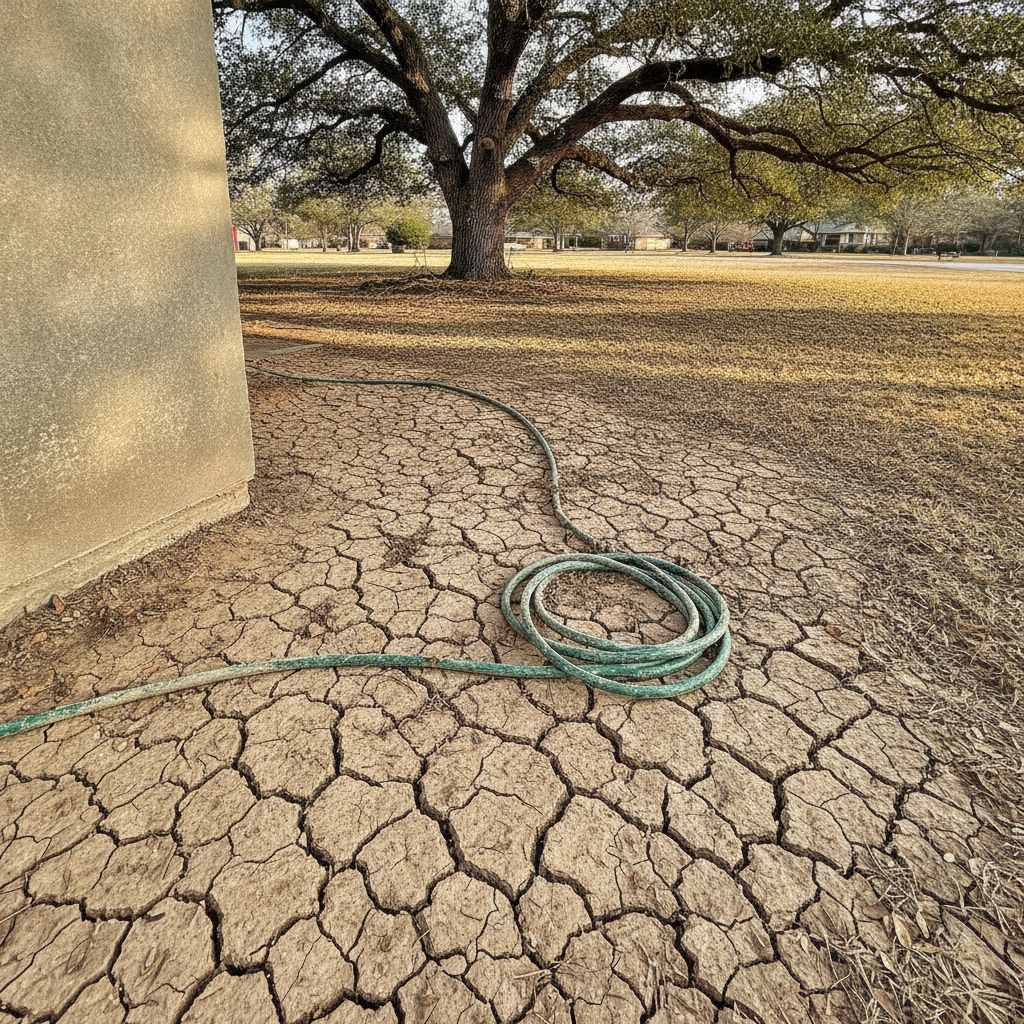
For homeowners in Dallas, Fort Worth, Arlington, and the Blackland Prairie counties, there is a real problem worth solving. North and central Texas sits on expansive clay soil. When that clay gets wet, it can swell dramatically. But during brutal heat and drought, it dries out, shrinks and can pull away from a home's foundation. That can leave gaps beneath the slab, allowing the foundation to settle and leading to further damage inside the home. In that narrow context, on clay with good perimeter drainage, watering during dry periods can slow differential settlement by maintaining more stable moisture beneath the slab edge.
But here is what the popular myth ignores: Not every home needs the same watering schedule. Soil type, drainage, trees, lot grading, sun exposure, foundation type, and prior movement history all matter. A soaker hose deployed blindly is not engineering. It is guesswork dressed up as maintenance.
The physical mechanism is moisture tension at depth. When clay loses water, it shrinks. The perimeter soils lose contact with the slab edge, and the foundation loses support where it matters most. Watering the perimeter can theoretically arrest that loss by keeping moisture stable. But if you are on sandy soil, over-watering fast-drains the excess away and creates pools of water that then evaporate, creating exactly the same uneven drying you were trying to prevent. And if you already have poor drainage, standing water near the foundation will drive moisture laterally under the slab, where it promotes differential lift, causing cracks that don't settle back when the soil dries again.
Tree roots are another silent killer. Mature trees draw moisture aggressively from the soil, causing localized drying and shrinkage on the side closest to the tree. Watering one side of the house cannot compete with an oak that has been pulling moisture from 30 feet of radius for twenty years. If you water the perimeter but the oak side stays dry, you create a moisture gradient that bends the slab in the opposite direction from the usual pattern. That is not stabilization. That is expensive redirection of damage.
What It Means for a North Texas Homeowner
Do not water your foundation based on a neighbor's routine or a video. Do this instead:
- Confirm your soil type and plasticity. Know whether you are on high-shrink clay, sandy clay, loam, or sand. A simple soils report from your permitting documents, or a Phase I environmental assessment, will tell you. Clay soil found throughout Dallas, Fort Worth, Arlington and throughout North Texas has an incredible capacity to expand when wet and shrink when dry. If your home was built on clay soil, you'll need to water more often and in more significant quantities to maintain consistent moisture levels and prevent the soil from shifting, causing damage to the foundation. If you are on sandy soil or loam, watering may not help, and excess water will cause its own problems.
- Assess drainage before you buy a hose. Walk your lot after a heavy rain. Does water pool near the perimeter? Does it run downhill or toward the house? Negative grading, where yard slopes toward the house instead of away from it, directs rainwater straight toward the perimeter. Pooling water near the perimeter signals that moisture is soaking into the soil unevenly. Fix the grade and gutters first. Watering on top of poor drainage is like bailing a boat with a hole in it.
- Map trees and root zones. Large trees within 30 feet of your foundation are extracting moisture independently of your watering schedule. If you have an old oak, live oak, or pecan on the foundation-side perimeter, watering the far side will not compensate. You will create the very differential movement you are trying to prevent. In that case, drainage management and grading matter more than watering.
- Get an engineering assessment, not a contractor estimate. A PE-licensed structural engineer can tell you whether watering will help your specific foundation, soil, drainage, and lot configuration. A foundation repair salesman will recommend repairs. An engineer will tell you if you need them, or if moisture management alone will suffice. That is not a small distinction.
- If you do water, use a drip system, not a soaker hose. A perimeter drip system maintains uniform moisture around the entire foundation, so when rain adds water to one side, the other sides are already at a similar moisture level. A soaker hose, moved by hand or dragged across the yard, creates patches of saturation and drying. Uneven watering is worse than no watering.
September is when foundation stress peaks in North Texas. The summer dry has pulled moisture from clay below the surface. Interior soils are still stable. Perimeter soils have shrunk. The slab sits on an uneven bed. It is real. But the answer is not panic watering. The answer is understanding your soil, your drainage, and your site. Get a pre-purchase engineering evaluation if you are buying and see what the ground beneath the house is actually doing. If you own and are seeing cracks, call a structural engineer before calling a repair company. Water only if an engineer tells you it will help. If it won't, watering will just make it worse, slower and more expensively.
Disusun dengan bantuan AI dan ditinjau terhadap sumber publik yang dirujuk di atas. Bukan pengganti inspeksi bersegel PE.