
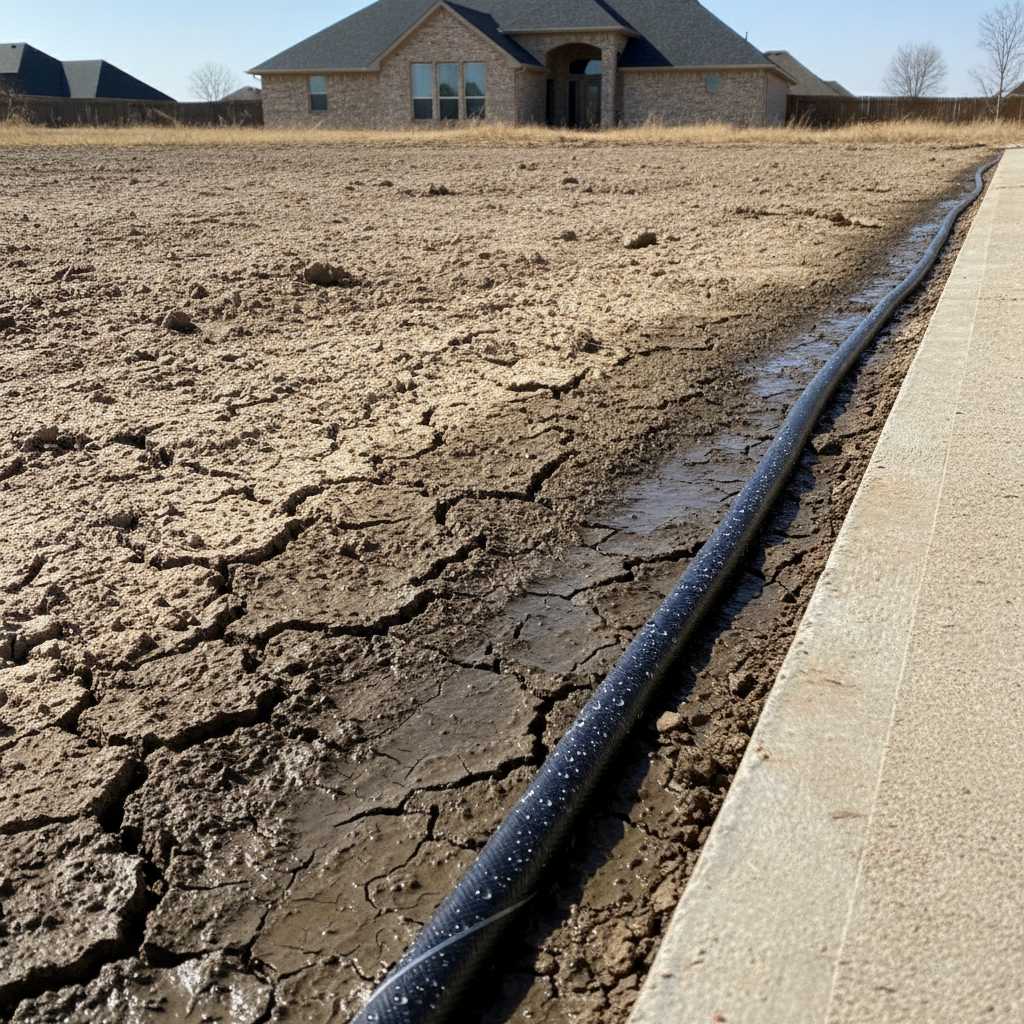
The trigger: A soaker hose placed 12 to 18 inches out from the slab, run consistently on a schedule during drought, keeps soil moisture stable and is one of the simplest, most effective forms of foundation protection a homeowner can use. That advice appeared recently from a well-regarded North Texas builder and sounds reassuring. But it sidesteps the hard part: what "consistent" and "most effective" actually demand from a homeowner, and what happens when discipline breaks down. Read the full TriStar Built article here.
The Physics Is Real, but the Execution Is Fragile
The mechanism behind foundation watering is sound. North Texas soil contains a high concentration of expansive clay, which reacts dramatically to moisture changes. During droughts, the soil shrinks and pulls away from the foundation. When heavy rain arrives, the soil expands rapidly and places pressure against the structure. The movement is rarely even across the entire footprint of a home. One side of a slab may stay damp because of poor drainage or shade, while another side dries out faster in direct sun. This uneven movement is what cracks foundations, moves door frames, and breaks interior drywall. If you can stabilize soil moisture around the perimeter, you reduce that differential settling. That part is not marketing; it is geotechnics.
But here is where popular advice and real-world performance diverge. Consistency is not optional; it is the entire ballgame. Most Texans soak their foundations in irregular intervals. Inconsistent soaking reduces swelling concerns in your soil, but increases the amount of shrinkage. This increases the risk of foundation shifting and settling. In other words, turning a soaker hose on sporadically or for a week then forgetting it is worse than not watering at all. You have set up a cycle of dry, wet, dry, wet that the clay responds to by moving. You traded drought shrinkage for human-caused movement.
Three Ways Homeowners Mess It Up
First: overwatering. If the soaker hose is too close to the home, when the dry soil cracks, the water can follow the cracks under your home and create additional problems. A neighbor put in a soaker hose and turned it on around 7 p.m. and came back at 11 p.m. Four hours of water resulted in water entering the foundation as well as making a small swimming pond in the next yard over. Overwatering also pushes water into cracks and voids, destabilizing the bearing layer and sometimes causing the foundation edge to heave. Rapid saturation can cause the soil to swell, pushing upward on the foundation edges in a process known as upheaval.
Second: wrong placement or pressure. The hose should be positioned between 6 to 24 inches away from the foundation wall. Positioning the hose too close can lead to over-saturation and soil erosion directly at the perimeter, potentially worsening settlement issues. This distance ensures the water penetrates deep enough to hydrate the expansive clay without creating a saturated zone adjacent to the concrete. Most homeowners lay the hose down and assume it works. The hose functions by slowly weeping water through tiny pores, operating best at low pressure, usually between 10 and 25 PSI. High water pressure foils the entire strategy.
Third: reactive watering after damage appears. Many Texans water their foundations as a reactionary measure when they see a small foundation crack. By then, you are trying to stabilize a slab that has already moved. A crack means the foundation has already shifted; adding water now does not undo that movement. You may slow further movement, but the repair work is already baked in.
What This Means for a Texas Homeowner
If your home is in active-zone clay (most of North Texas qualifies), and drought is underway or predicted, soaker hose watering can help prevent new movement during that dry period. But it requires you to commit to a schedule from June through September, checking soil moisture weekly, adjusting for rain, and accepting that you are doing maintenance, not one-time protection. Expect to run your hoses for 15 to 20 minutes per day, three to five days per week in peak summer heat. In drought conditions, you may need to water up to 45 minutes every day. That is not "simple."
Do not water a foundation that is already showing signs of movement (cracks, stuck doors, sloping floors, gaps at windows). Get a professional inspection first. Watering will not fix what has moved; it may mask symptoms while damage worsens under the surface. If your slab has settled, it needs structural repair (piers, leveling, or drainage correction), not maintenance.
And be honest about your follow-through. If you cannot commit to a schedule, or if you live somewhere that gets unpredictable summer rain, you are better off investing in good perimeter drainage and grading to keep water away from the foundation edge, rather than trying to manage soil moisture by hand. Drainage is passive; watering is active and forgiving only of discipline.
For older homes showing sustained movement patterns, a structural engineer can assess whether your soil is stable enough to benefit from watering, or whether the real problem is a plumbing leak, poor grading, or a failed pier system that watering will only delay addressing. The cost of a report is far cheaper than the cost of running soaker hoses for five years only to discover you needed drainage work or foundation repair all along.
Disusun dengan bantuan AI dan ditinjau terhadap sumber publik yang dirujuk di atas. Bukan pengganti inspeksi bersegel PE.