
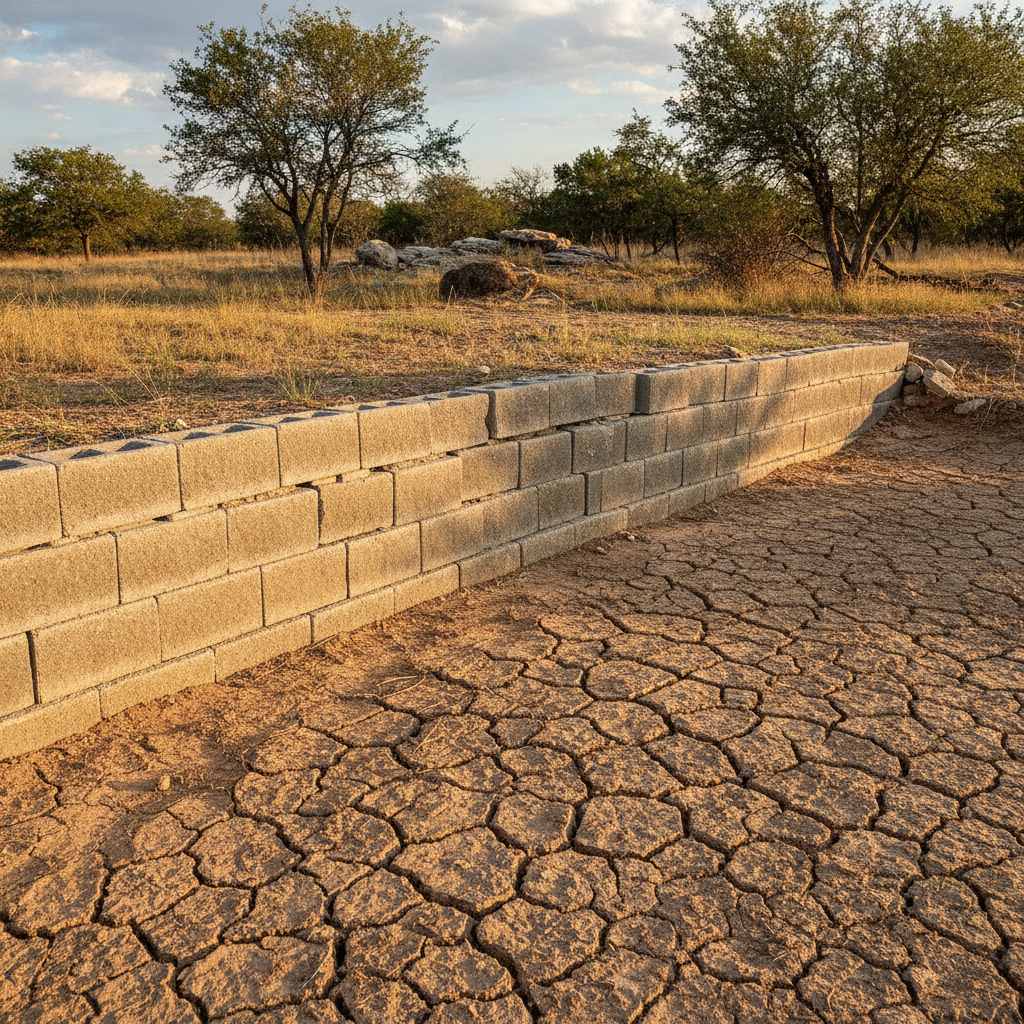
The Trigger: In May 2025, residents of Canyon Falls Homeowners Association in Northlake asked the town council for help funding and accelerating repairs to retaining walls on public trails, with estimates around $1 million. Speakers described the retaining wall failure as both a safety risk and a threat to a community asset. A community HOA that should have nothing to worry about is instead facing a seven-figure liability. Read the Citizen Portal report here.
Why This Matters: The Real Mechanism of Failure
Canyon Falls isn't unique. North Texas retaining walls fail because of a specific collision between three unchangeable facts: clay soil, wet-dry cycles, and inadequate drainage design. Understanding the physics helps you avoid the same trap.
North Texas's expansive montmorillonite clay causes seasonal ground movement of 3 to 6 inches. That's enormous movement over a single year. When a retaining wall is built without accounting for that, or without robust drainage behind it, forces build up. Water buildup behind a retaining wall often causes more failures than soil weight alone. When drainage is inadequate, hydrostatic pressure develops and pushes aggressively against the structure.
The sequence is relentless: heavy rain saturates the soil behind the wall. The water can't drain freely because the design lacked a proper drainage zone or because decades of sediment and fine clay particles have clogged whatever drainage was installed. Water pressure builds. The soil expands as it absorbs moisture. A leaning retaining wall is often a sign of foundation movement, poor drainage, or inadequate construction in the first place. In North Texas, our heavy clay soil contracts and expands dramatically between wet winters and dry summers, putting constant cyclical pressure on these structures. The wall leans. Once it starts to lean, the structural geometry goes wrong. The structural integrity of a retaining wall depends on it being plumb and properly anchored. Once it begins to tilt, the forces acting on it become increasingly unbalanced and the process accelerates.
The killer detail: North Texas is experiencing a building boom and the situation is like the wild west out here. Many walls installed during previous construction booms cut corners on drainage specifications. They were "good enough" for 10 or 15 years. Now they're failing.
What This Means for You: Before You Buy or Build
If you are buying a home in North Texas with a retaining wall on the property, or you are responsible for one as an HOA, do not treat this as a cosmetic issue. A wall that is leaning, cracking at the base, or showing horizontal cracks is not something to monitor or patch. Get a professional assessment now.
For homeowners: Stricter 2021/2024 IBC codes require engineering fees, geogrid reinforcement, and premium labor rates driven by the skilled mason shortage. If your wall was built before 2020, it almost certainly does not meet current code. That doesn't mean it will fail tomorrow, but it means you are sitting on deferred liability. The time to fix it is before you sell, before it collapses onto a neighbor's property, or before an HOA repair bill lands on your lot.
For property buyers: After ice storms and snow melt in February 2026, a retaining wall in North Texas couldn't take the load. Water-related failure is no longer theoretical. Request a professional retaining wall inspection as part of your due diligence. Do not rely on a general home inspector. You need a structural engineer who can evaluate the base, the drainage zone, the soil composition, and the current tilt.
For HOAs and developers: The Canyon Falls case is a preview of liability if common-area retaining walls were undersized or under-drained during initial construction. A $1 million repair today was likely preventable with $50,000 in proper drainage and engineering 10 years ago. Proactive drainage and grading evaluation before failure is always cheaper than emergency repair or replacement.
If you own a property in North Texas with a retaining wall and you haven't had it professionally assessed, the time to act is now. Deferred maintenance on retaining walls compounds. Contact a PE-licensed structural engineer to schedule an inspection. Document the current condition with photos. If you are selling a home, a pre-listing engineer report will give buyers confidence and protect you from future claims. If the wall is failing, repair it under your control, not under an HOA assessment or a lawsuit.
Disusun dengan bantuan AI dan ditinjau terhadap sumber publik yang dirujuk di atas. Bukan pengganti inspeksi bersegel PE.