
Reacting to: The Katy News
The Trigger
Many homeowners are surprised to learn that even relatively new houses can experience foundation issues if drainage, soil conditions, and moisture levels are not properly managed. That was the finding in a recent survey of Texas foundation problems. The surprise itself reveals the problem. Most homeowners and even some contractors treat the foundation as the customer and the soil as just whatever is underneath. It is backwards. In Texas clay country, the soil drives the story. Understanding that story starts with a concept most people have never heard of: the active zone.
What the Active Zone Actually Is
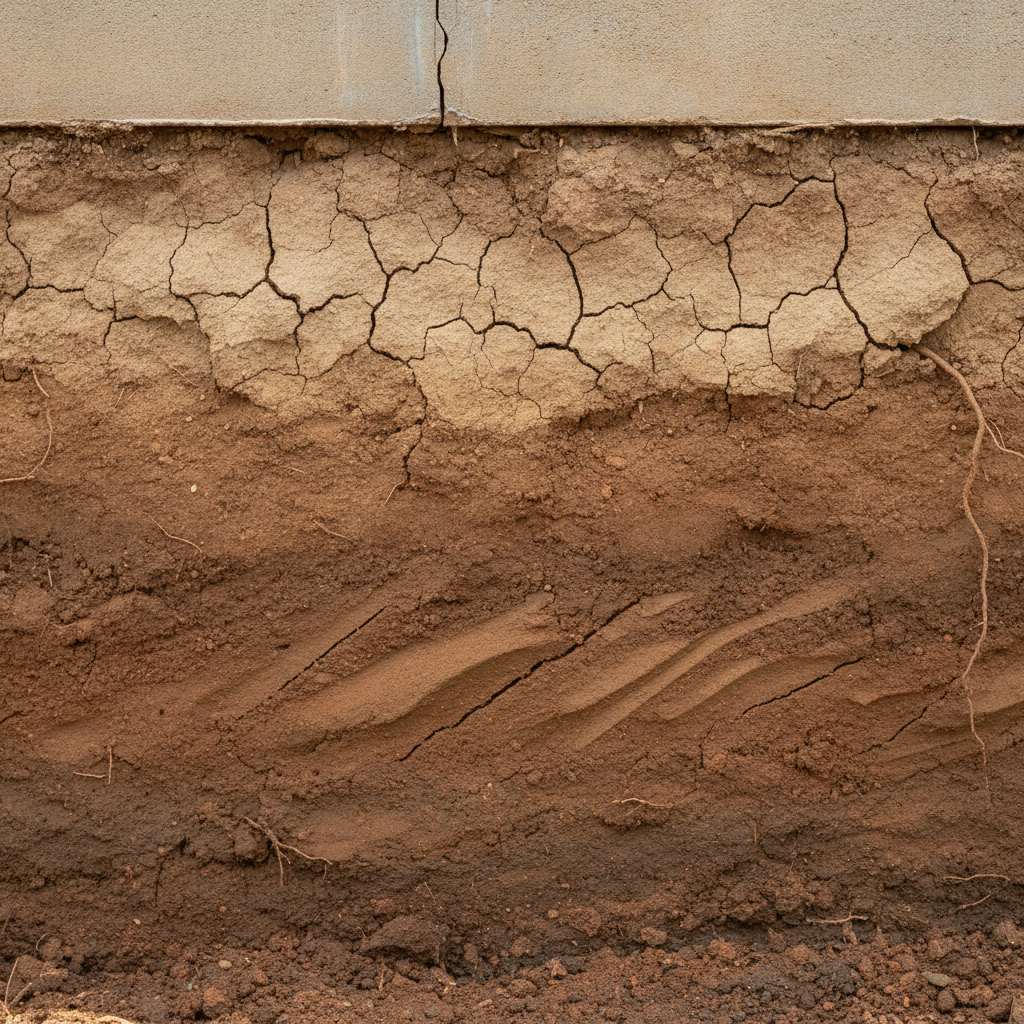
The active zone is not a code term. It is a physical reality in Texas soil. It is the layer of clay nearest the surface, typically 3 to 6 feet down (sometimes deeper), where moisture and temperature fluctuations trigger the most dramatic volume change. This is where montmorillonite clay absorbs rainfall and expands in spring, then dries and shrinks back in summer. Twice a year. Every year.
A foundation pier driven down 20 feet may rest on stable soil below that zone. But that pier still sits in a house supported by a beam that spans across the active zone. The clay on either side of the pier is swelling and shrinking. That creates a see-saw effect. The pier holds one point down; the clay next to it lifts and falls. This is not a flaw in pier design. It is geology asserting itself.
Texas Vertisols can expand by 30 percent or more in volume when saturated, and shrink back almost as dramatically when dry. That is not a small number. A cubic yard of this soil changes shape like it is breathing. Now picture thousands of cubic yards surrounding your home, all breathing in rhythm with the seasons, all pushing and pulling on your foundation frame.
Why Standard Repair Thinking Fails
The conventional repair response is: the foundation is moving, so add a pier. The pier works. It stabilizes one point. But if you do not address the soil that is driving the movement, you are fighting the weather, not solving the problem. The clay keeps moving. The house is now pinned at multiple points, creating bending stress on the frame itself. Some contractors install adjustable piers and then readjust them seasonally. That is expensive and it treats the symptom, not the cause.
What actually determines whether a repair lasts decades or fails in five years is whether the moisture level in that active zone is managed. Moisture is the trigger. Without it, the clay does not expand. Without expansion, there is no pressure pushing your foundation up. The piers become permanent anchors rather than continual damage-control devices.
A lime stabilization program that adds $30,000 to a commercial pad project budget can prevent $500,000 in foundation repair costs ten years later. That math is not sloppy. It is engineering. When you change the soil's ability to absorb and release moisture, you flatten the active zone. The soil still changes season to season, but not by 30 percent. It might move 5 percent. Your foundation can tolerate that.
What This Means for Your Home
If you own a home in North Texas, assume your lot contains high-plasticity clay. If it has ever cracked or settled, it definitely does. Your foundation repair plan should have three parts, in this order:
- Drainage first. Surface water should move away from the house, not pool near it. Gutters, downspouts, and grading matter. They control how much water soaks into the active zone. A $500 grading fix can prevent a $30,000 repair.
- Moisture maintenance second. Do not overwater your foundation during drought. Do not underwater it either. The goal is steady-state, not wild swings. Vegetation planted too close to the house (within 10 feet) will draw water out of the clay and accelerate shrinkage.
- Structural support third. Once moisture is controlled, add piers if movement persists. But your contractor should be able to show you a geotechnical report that quantifies the soil's expansion potential and a plan that treats the active zone itself, not just the symptoms above it.
If a contractor leads with piers and skips soil analysis, you are likely to be back in 10 years with new cracks and another repair bill. If a contractor mentions soil stabilization or detailed drainage design, that is the right conversation.
Before you buy a home in Texas, hire a licensed structural engineer for a foundation inspection. Not a home inspector. Not a contractor. An engineer. Cost is $300 to $800. It will tell you whether the soil under that house is actively moving, whether prior repairs were done right, and what maintenance schedule will actually extend the foundation's life. That information is worth thousands of dollars of certainty. After you own the home, a professional foundation inspection every 3 to 5 years catches problems before they double in cost.
The active zone is not going away. Texas heat and drought and rain will keep cycling through. But understanding what drives the movement, and addressing it methodically instead of reactively, is what separates homeowners who live in peace from those who chase cracks for decades.
Grading and drainage evaluation is the first engineering step. If you suspect active movement, a structural assessment will quantify it. Both are sealed, professional work that protects your investment far better than another coat of concrete patch.
Disusun dengan bantuan AI dan ditinjau terhadap sumber publik yang dirujuk di atas. Bukan pengganti inspeksi bersegel PE.