
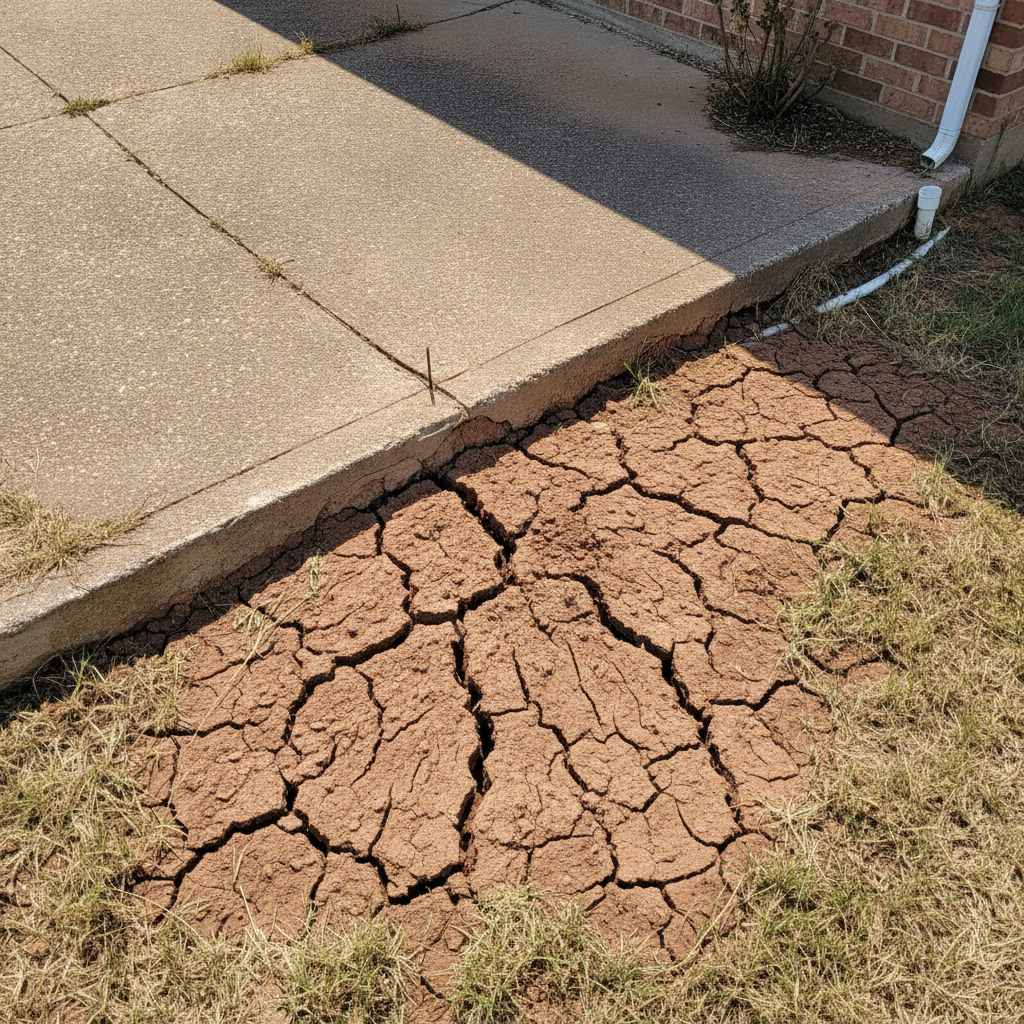
The Trigger. Highland Homes shifted from 10-year to 6-year structural warranty effective January 1, 2026, and Texas law now permits builders to reduce structural warranty coverage from 10 years down to 6 years. This is legal. It is not necessarily safe on our soil.
Why Six Years Is Not Enough in Dallas-Fort Worth
The warranty window shrinks, but the clay beneath your foundation does not. Expansive clay in Dallas, Tarrant, Denton, and Collin counties responds to moisture on a cycle measured in seasons, not months. A typical new home in DFW will go through roughly six complete wet-dry cycles in six years: one spring saturation, one summer drought, and back again. The first cycle or two can be deceptive. The real stress accumulates in years 4, 5, and 6, when the foundation has moved incrementally in one direction, then reversed, compressing and re-stressing concrete multiple times. Uneven settlement patterns that started as hairline cracks in year 3 can become bowing or step-cracking by year 7 or 8, well past the warranty deadline.
The physical mechanism is this: soil below roughly 18 inches contains the "active zone" where moisture fluctuation is most aggressive. If a contractor shortcuts the exploration, treating soil data as generic rather than site-specific, piers or slab edges may not go deep enough to reach stable bearing strata. The foundation will hold fine for the first few years because the contractor built to the legal minimum, not to the soil's actual demand. Then, as clay shrinks and expands in deeper cycles, the under-seated support gives way. By year 6.5, the homeowner owns the problem.
The Contractor Incentive Problem
When the warranty window is 10 years, a builder is liable if your foundation fails in year 7 and you can prove it was caused by defective design or workmanship. When the window is 6 years, that same builder faces no recovery risk after month 72. The economic pressure shifts: cut the soil investigation costs, use standard pier depths, move to the next lot. The home will feel solid for six years. By the time differential movement becomes obvious, the builder is out of pocket and the owner is looking for an engineering assessment to determine causation.
This is not conspiracy. This is math. Builders who are most cost-competitive do not carry extra margin for unknowns. A 6-year warranty gives them permission to treat North Texas clay as if it were stable soil in a dry climate. It is not.
What This Means for You
If you are buying new construction in North Texas in 2026, ask the builder in writing which statute of repose warranty they are offering. Highland Homes went public with 6-year coverage; many others have quietly followed. Some builders, including Pace Setter, Shaddock, David Weekley, and Perry Homes, still offer 10-year structural coverage. The difference is not just a headline. It is the difference between being protected when foundation issues emerge in year 7 or 8, and being on your own.
Do not assume a 6-year warranty is conservative or standard. It is legally permissible and increasingly common, but it is not engineered for Blackland Prairie clay. A clay soil that swells 30% when wet and shrinks proportionally in drought is not a 6-year problem; it is a 10-to-15-year problem, and sometimes longer.
Before closing, request a copy of the soil investigation report and the foundation design drawings. If the report is generic ("clay soil, typical for the area"), or if the design assumes shallow bearing without deep boring data, that is a red flag. A proper soil exploration should include borings specific to your lot, moisture content tests, and classification of the active zone depth. If your builder cannot provide that, you are buying on assumptions, not engineering.
Consider an independent Phase I structural inspection at year 5 or 6, while the warranty is still active. If cracks or movement are detected, you have a window to file a claim. If you wait until year 8, you are paying out of pocket for repairs that may have been the contractor's liability. Phase inspections during construction and immediately post-completion are cheap insurance; they create a timestamped record of baseline condition and give you legal leverage if problems emerge near the end of the warranty period.
For properties in the DFW metro, especially in East County growth zones where Highland and similar builders are active, the structural warranty length is now a legitimate valuation factor. A 10-year warranty on Blackland Prairie clay is worth negotiating for. A 6-year warranty should carry a discount or require additional protective measures (deeper soil investigation, higher-performance fill, post-construction structural monitoring).
Texas law may allow shorter warranties, but North Texas soil does not care about law. It moves on a schedule set by rain and heat, not by contract expiration dates. A builder's shift to 6-year coverage does not change the physics of clay shrink-swell. It only shifts who pays when the physics catches up.
Disusun dengan bantuan AI dan ditinjau terhadap sumber publik yang dirujuk di atas. Bukan pengganti inspeksi bersegel PE.